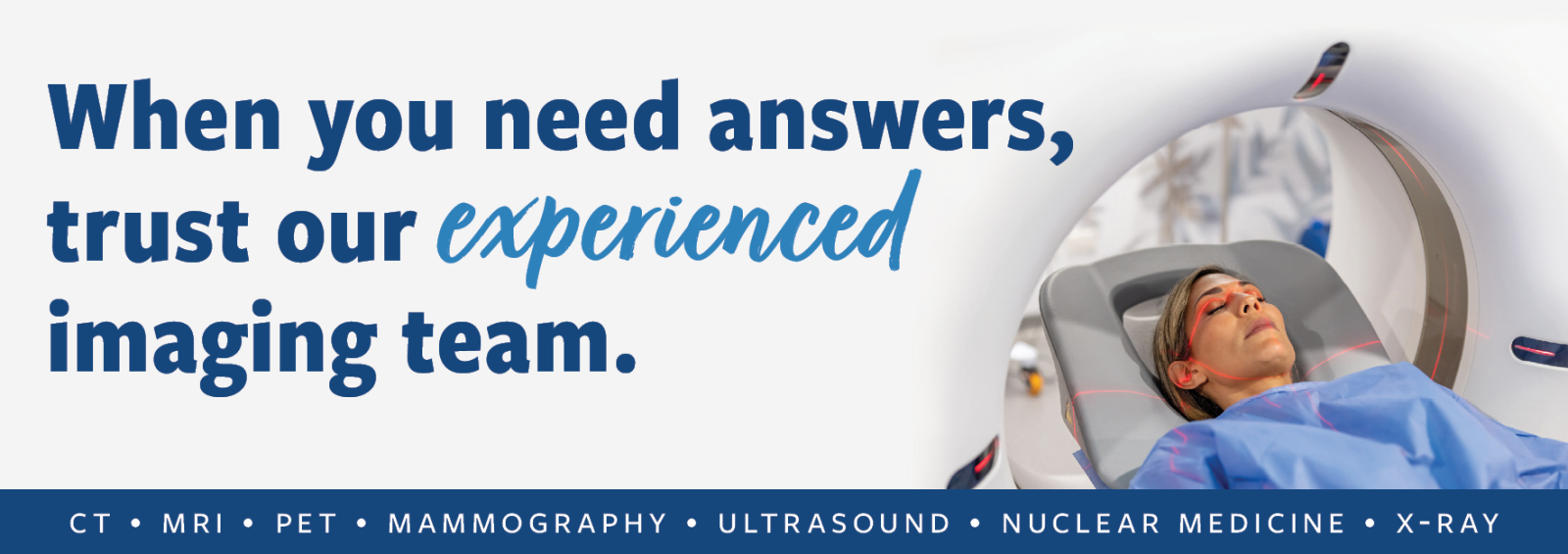
Diagnostic Imaging
Maury Regional Hospital
uses a wide range of radiology methods as diagnostic tools. Using health
information gathered through sound and magnetic waves as well as X-rays, you
and your doctors can make quick, informed health care decisions.
We are also committed to helping you maintain your health by offering wellness screenings to detect blockages in the circulatory system, cancer and stones.
Board-certified radiologists
are specially trained in CT, MRI, PET, mammography, ultrasound and nuclear
medicine. Some have received fellowship training in neuroradiology, interventional
radiology, and musculoskeletal radiology.
Computed Tomography (CT)
A CT scan uses X-rays
combined with a computer to capture multiple cross-sectional images, or "slices" in
rapid sequence, similar to slices from a loaf of bread. These pictures
let the radiologist see the bones and soft tissues within the body more clearly.
Typically, CT scans will focus on a specific area of the body. Then, the CT
scanner is rotated around your body capturing high quality images and decreasing
the time it takes to conduct a scan. In addition to a 4-slice and 16-slice CT, Maury Regional Hospital utilizes a 64-slice CT, one of the most powerful diagnostic tools available.
Maury Regional Hospital
now offers screenings to individuals age 50 and older with no pre-existing
conditions. Click here for more information on Maury Regional's screening
CT.
CT services are available at Maury Regional Hospital, Spring Hill Imaging Center, Marshall
Medical Center and Wayne Medical
Center.
Magnetic Resonance Imaging (MRI) - 1.5 Tesla
Magnetic Resonance Imaging
uses a powerful magnetic field combined with radio waves to stimulate the body’s
water molecules. These stimulated molecules release signals that produce cross-sectional
images similar to pictures of slices through the body. A special computer analyzes
this information and creates an image of the tissue or bone on a video screen.
Magnetic Resonance Imaging
is available at Maury Regional Hospital, Spring Hill Imaging Center, and Marshall
Medical Center.
Positron Emission Tomography (PET)
PET is an imaging procedure that generates pictures of the precise location and extent of disease. It is the only tool that can accurately image many organs at one time to diagnose malignancy and provide information about whether or not cancer has spread to other parts of the body. A PET scan is a safe and painless procedure, which typically takes about one hour to complete.
Ultrasound
Ultrasound is a technique
that sends high frequency sound waves into the body. While ultrasound is often
used by doctors and parents-to-be to monitor the health of an unborn baby,
ultrasound is also useful in examining specific organs of the body. High-frequency
sound waves hit the target body part and bounce back as a series of echoes.
An ultrasound scanner detects these echoes and analyzes the information to
create an image.
Maury Regional Hospital offers affordable ultrasound screenings, including vascular screenings to detect blockages in the circulatory system and organ screenings to detect stones and cancers. For more information, click here.
Ultrasound imaging is
available at Maury Regional Hospital, Spring Hill Imaging Center, Lewis
Ambulatory Care Center, Marshall
Medical Center and Wayne Medical
Center.
Mammography
Mammography is a simple
technique of obtaining X-rays of the breast. While most detectable masses of
1.5 to 2 centimeters or more can usually be felt through breast self-examination,
smaller lumps located deep within the breast tissue can be detected only by
X-ray. Mammography involves passing low doses of X-rays through the breasts
and does not require any dyes or injections. Screening mammograms may be conducted without a physician's referral and patients can feel secure knowing that a computer-aided detection (CAD) system is used by radiologists to aid in the early diagnosis of breast cancer.
Mammography is available at Maury Regional Hospital, Spring Hill Imaging Center, Lewis
Ambulatory Care Center, Marshall
Medical Center and Wayne Medical
Center.
Nuclear Medicine
Nuclear medicine allows doctors to assess tissue function, metabolism and blood flow. An imaging agent is injected into the patient. Different agents are used to examine specific organs. Once injected, a gamma camera records the radioactivity emitted by the organ and surrounding tissue. Tracking these waves allows your doctors to make an accurate assessment of organ or tissue function.
Nuclear Medicine is available at Maury Regional Hospital and Marshall
Medical Center.
Bone Densitometry
Bone densitometry measures changes in bone density. This test is a valuable tool your doctors can use to monitor and treat osteopenia or osteoporosis, diseases in which the bone's mineral content and density are low and the risk of fractures is high.
Bone Densitometry is available at Maury Regional Hospital, Marshall
Medical Center and Wayne Medical Center.
Locations and Hours of Operation:
Maury Regional Hospital
1224 Trotwood Avenue
Columbia, TN 38401
931.381.1111
24 hours a day
Maury Regional Outpatient Pavilion
1220 Trotwood Avenue
Columbia, TN 38401
931.381.1111
Monday – Friday
7:00 a.m. – 7:00 p.m.
Spring Hill Imaging Center
5421 Main Street
Spring Hill, TN 37174
615.794.7922 or 931.486.3425
Monday - Friday
8:00 a.m. – 6:00 p.m.
Lewis Ambulatory Care Center
617 W Main Street
Hohenwald, TN 38462
931.796.6222
Monday – Friday
8:00 a.m. – 5:00 p.m.
Saturday
9:00 a.m. - 5:00 p.m.
Sunday
1:00 a.m. - 5:00 p.m.
Marshall Medical Center
1080 North Ellington Parkway, Lewisburg, TN 37091
931.359.6241, extension 3340
Monday – Friday
8:00 a.m. – 4:00 p.m.
Wayne Medical Center
103 J.V. Mangubat Drive, Waynesboro, TN 38485
931.722.5411
Monday – Friday
8:00 a.m. – 4:00 p.m.
Please note: prior to scheduling an appointment, your physician must order the procedures.
|